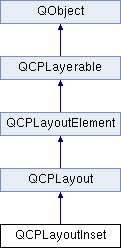
A layout that places child elements aligned to the border or arbitrarily positioned. More...
Public Types | |
| enum | InsetPlacement { ipFree, ipBorderAligned } |
 Public Types inherited from QCPLayoutElement Public Types inherited from QCPLayoutElement | |
| enum | SizeConstraintRect { scrInnerRect, scrOuterRect } |
| enum | UpdatePhase { upPreparation, upMargins, upLayout } |
Public Member Functions | |
| void | addElement (QCPLayoutElement *element, Qt::Alignment alignment) |
| void | addElement (QCPLayoutElement *element, const QRectF &rect) |
| virtual QCPLayoutElement * | elementAt (int index) const Q_DECL_OVERRIDE |
| virtual int | elementCount () const Q_DECL_OVERRIDE |
| Qt::Alignment | insetAlignment (int index) const |
| InsetPlacement | insetPlacement (int index) const |
| QRectF | insetRect (int index) const |
| QCPLayoutInset () | |
| virtual double | selectTest (const QPointF &pos, bool onlySelectable, QVariant *details=0) const Q_DECL_OVERRIDE |
| void | setInsetAlignment (int index, Qt::Alignment alignment) |
| void | setInsetPlacement (int index, InsetPlacement placement) |
| void | setInsetRect (int index, const QRectF &rect) |
| virtual void | simplify () Q_DECL_OVERRIDE |
| virtual bool | take (QCPLayoutElement *element) Q_DECL_OVERRIDE |
| virtual QCPLayoutElement * | takeAt (int index) Q_DECL_OVERRIDE |
| virtual void | updateLayout () Q_DECL_OVERRIDE |
| Public Member Functions inherited from QCPLayout | |
| void | clear () |
| virtual QList< QCPLayoutElement * > | elements (bool recursive) const Q_DECL_OVERRIDE |
| QCPLayout () | |
| bool | remove (QCPLayoutElement *element) |
| bool | removeAt (int index) |
| virtual void | update (UpdatePhase phase) Q_DECL_OVERRIDE |
| Public Member Functions inherited from QCPLayoutElement | |
| QCP::MarginSides | autoMargins () const |
| QCPLayout * | layout () const |
| QCPMarginGroup * | marginGroup (QCP::MarginSide side) const |
| QHash< QCP::MarginSide, QCPMarginGroup * > | marginGroups () const |
| QMargins | margins () const |
| virtual QSize | maximumOuterSizeHint () const |
| QSize | maximumSize () const |
| QMargins | minimumMargins () const |
| virtual QSize | minimumOuterSizeHint () const |
| QSize | minimumSize () const |
| QRect | outerRect () const |
| QCPLayoutElement (QCustomPlot *parentPlot=0) | |
| QRect | rect () const |
| void | setAutoMargins (QCP::MarginSides sides) |
| void | setMarginGroup (QCP::MarginSides sides, QCPMarginGroup *group) |
| void | setMargins (const QMargins &margins) |
| void | setMaximumSize (const QSize &size) |
| void | setMaximumSize (int width, int height) |
| void | setMinimumMargins (const QMargins &margins) |
| void | setMinimumSize (const QSize &size) |
| void | setMinimumSize (int width, int height) |
| void | setOuterRect (const QRect &rect) |
| void | setSizeConstraintRect (SizeConstraintRect constraintRect) |
| SizeConstraintRect | sizeConstraintRect () const |
| Public Member Functions inherited from QCPLayerable | |
| bool | antialiased () const |
| QCPLayer * | layer () const |
| QCPLayerable * | parentLayerable () const |
| QCustomPlot * | parentPlot () const |
| QCPLayerable (QCustomPlot *plot, QString targetLayer=QString(), QCPLayerable *parentLayerable=0) | |
| bool | realVisibility () const |
| void | setAntialiased (bool enabled) |
| Q_SLOT bool | setLayer (QCPLayer *layer) |
| bool | setLayer (const QString &layerName) |
| void | setVisible (bool on) |
| bool | visible () const |
Protected Attributes | |
| QList< QCPLayoutElement * > | mElements |
| QList< Qt::Alignment > | mInsetAlignment |
| QList< InsetPlacement > | mInsetPlacement |
| QList< QRectF > | mInsetRect |
| Protected Attributes inherited from QCPLayoutElement | |
| QCP::MarginSides | mAutoMargins |
| QHash< QCP::MarginSide, QCPMarginGroup * > | mMarginGroups |
| QMargins | mMargins |
| QSize | mMaximumSize |
| QMargins | mMinimumMargins |
| QSize | mMinimumSize |
| QRect | mOuterRect |
| QCPLayout * | mParentLayout |
| QRect | mRect |
| SizeConstraintRect | mSizeConstraintRect |
| Protected Attributes inherited from QCPLayerable | |
| bool | mAntialiased |
| QCPLayer * | mLayer |
| QPointer< QCPLayerable > | mParentLayerable |
| QCustomPlot * | mParentPlot |
| bool | mVisible |
Additional Inherited Members | |
| Signals inherited from QCPLayerable | |
| void | layerChanged (QCPLayer *newLayer) |
| Protected Member Functions inherited from QCPLayout | |
| void | adoptElement (QCPLayoutElement *el) |
| QVector< int > | getSectionSizes (QVector< int > maxSizes, QVector< int > minSizes, QVector< double > stretchFactors, int totalSize) const |
| void | releaseElement (QCPLayoutElement *el) |
| void | sizeConstraintsChanged () const |
| Protected Member Functions inherited from QCPLayoutElement | |
| virtual void | applyDefaultAntialiasingHint (QCPPainter *painter) const Q_DECL_OVERRIDE |
| virtual int | calculateAutoMargin (QCP::MarginSide side) |
| virtual void | draw (QCPPainter *painter) Q_DECL_OVERRIDE |
| virtual void | layoutChanged () |
| virtual void | parentPlotInitialized (QCustomPlot *parentPlot) Q_DECL_OVERRIDE |
| Protected Member Functions inherited from QCPLayerable | |
| void | applyAntialiasingHint (QCPPainter *painter, bool localAntialiased, QCP::AntialiasedElement overrideElement) const |
| virtual QRect | clipRect () const |
| virtual void | deselectEvent (bool *selectionStateChanged) |
| void | initializeParentPlot (QCustomPlot *parentPlot) |
| virtual void | mouseDoubleClickEvent (QMouseEvent *event, const QVariant &details) |
| virtual void | mouseMoveEvent (QMouseEvent *event, const QPointF &startPos) |
| virtual void | mousePressEvent (QMouseEvent *event, const QVariant &details) |
| virtual void | mouseReleaseEvent (QMouseEvent *event, const QPointF &startPos) |
| bool | moveToLayer (QCPLayer *layer, bool prepend) |
| virtual void | selectEvent (QMouseEvent *event, bool additive, const QVariant &details, bool *selectionStateChanged) |
| virtual QCP::Interaction | selectionCategory () const |
| void | setParentLayerable (QCPLayerable *parentLayerable) |
| virtual void | wheelEvent (QWheelEvent *event) |
| Static Protected Member Functions inherited from QCPLayout | |
| static QSize | getFinalMaximumOuterSize (const QCPLayoutElement *el) |
| static QSize | getFinalMinimumOuterSize (const QCPLayoutElement *el) |
Detailed Description
A layout that places child elements aligned to the border or arbitrarily positioned.
Elements are placed either aligned to the border or at arbitrary position in the area of the layout. Which placement applies is controlled with the InsetPlacement (setInsetPlacement).
Elements are added via addElement(QCPLayoutElement *element, Qt::Alignment alignment) or addElement(QCPLayoutElement *element, const QRectF &rect). If the first method is used, the inset placement will default to ipBorderAligned and the element will be aligned according to the alignment parameter. The second method defaults to ipFree and allows placing elements at arbitrary position and size, defined by rect.
The alignment or rect can be set via setInsetAlignment or setInsetRect, respectively.
This is the layout that every QCPAxisRect has as QCPAxisRect::insetLayout.
Member Enumeration Documentation
Defines how the placement and sizing is handled for a certain element in a QCPLayoutInset.
| Enumerator | |
|---|---|
| ipFree |
The element may be positioned/sized arbitrarily, see setInsetRect. |
| ipBorderAligned |
The element is aligned to one of the layout sides, see setInsetAlignment. |
Constructor & Destructor Documentation
|
explicit |
Creates an instance of QCPLayoutInset and sets default values.
Member Function Documentation
| void QCPLayoutInset::addElement | ( | QCPLayoutElement * | element, |
| Qt::Alignment | alignment | ||
| ) |
Adds the specified element to the layout as an inset aligned at the border (setInsetAlignment is initialized with ipBorderAligned). The alignment is set to alignment.
alignment is an or combination of the following alignment flags: Qt::AlignLeft, Qt::AlignHCenter, Qt::AlighRight, Qt::AlignTop, Qt::AlignVCenter, Qt::AlignBottom. Any other alignment flags will be ignored.
| void QCPLayoutInset::addElement | ( | QCPLayoutElement * | element, |
| const QRectF & | rect | ||
| ) |
Adds the specified element to the layout as an inset with free positioning/sizing (setInsetAlignment is initialized with ipFree). The position and size is set to rect.
rect is given in fractions of the whole inset layout rect. So an inset with rect (0, 0, 1, 1) will span the entire layout. An inset with rect (0.6, 0.1, 0.35, 0.35) will be in the top right corner of the layout, with 35% width and height of the parent layout.
|
virtual |
Returns the element in the cell with the given index. If index is invalid, returns 0.
Note that even if index is valid, the respective cell may be empty in some layouts (e.g. QCPLayoutGrid), so this function may return 0 in those cases. You may use this function to check whether a cell is empty or not.
- See also
- elements, elementCount, takeAt
Implements QCPLayout.
|
virtual |
| Qt::Alignment QCPLayoutInset::insetAlignment | ( | int | index | ) | const |
Returns the alignment of the element with the specified index. The alignment only has a meaning, if the inset placement (setInsetPlacement) is ipBorderAligned.
| QCPLayoutInset::InsetPlacement QCPLayoutInset::insetPlacement | ( | int | index | ) | const |
Returns the placement type of the element with the specified index.
| QRectF QCPLayoutInset::insetRect | ( | int | index | ) | const |
Returns the rect of the element with the specified index. The rect only has a meaning, if the inset placement (setInsetPlacement) is ipFree.
|
virtual |
The inset layout is sensitive to events only at areas where its (visible) child elements are sensitive. If the selectTest method of any of the child elements returns a positive number for pos, this method returns a value corresponding to 0.99 times the parent plot's selection tolerance. The inset layout is not selectable itself by default. So if onlySelectable is true, -1.0 is returned.
See QCPLayerable::selectTest for a general explanation of this virtual method.
Reimplemented from QCPLayoutElement.
| void QCPLayoutInset::setInsetAlignment | ( | int | index, |
| Qt::Alignment | alignment | ||
| ) |
If the inset placement (setInsetPlacement) is ipBorderAligned, this function is used to set the alignment of the element with the specified index to alignment.
alignment is an or combination of the following alignment flags: Qt::AlignLeft, Qt::AlignHCenter, Qt::AlighRight, Qt::AlignTop, Qt::AlignVCenter, Qt::AlignBottom. Any other alignment flags will be ignored.
| void QCPLayoutInset::setInsetPlacement | ( | int | index, |
| QCPLayoutInset::InsetPlacement | placement | ||
| ) |
Sets the inset placement type of the element with the specified index to placement.
- See also
- InsetPlacement
| void QCPLayoutInset::setInsetRect | ( | int | index, |
| const QRectF & | rect | ||
| ) |
If the inset placement (setInsetPlacement) is ipFree, this function is used to set the position and size of the element with the specified index to rect.
rect is given in fractions of the whole inset layout rect. So an inset with rect (0, 0, 1, 1) will span the entire layout. An inset with rect (0.6, 0.1, 0.35, 0.35) will be in the top right corner of the layout, with 35% width and height of the parent layout.
Note that the minimum and maximum sizes of the embedded element (QCPLayoutElement::setMinimumSize, QCPLayoutElement::setMaximumSize) are enforced.
|
inlinevirtual |
The QCPInsetLayout does not need simplification since it can never have empty cells due to its linear index structure. This method does nothing.
Reimplemented from QCPLayout.
|
virtual |
Removes the specified element from the layout and returns true on success.
If the element isn't in this layout, returns false.
Note that some layouts don't remove the respective cell right away but leave an empty cell after successful removal of the layout element. To collapse empty cells, use simplify.
- See also
- takeAt
Implements QCPLayout.
|
virtual |
Removes the element with the given index from the layout and returns it.
If the index is invalid or the cell with that index is empty, returns 0.
Note that some layouts don't remove the respective cell right away but leave an empty cell after successful removal of the layout element. To collapse empty cells, use simplify.
Implements QCPLayout.
The documentation for this class was generated from the following files:
- projects/gui/3rdparty/qcustomplot/qcustomplot.h
- projects/gui/3rdparty/qcustomplot/qcustomplot.cpp